You have felt it: the dull ache behind the eyes after an hour of ordinary agarbatti, the way the room feels heavier rather than calmer. For a long time people assumed that was just what incense did. It is not. It is what the stick does.
Half the smoke is not fragrance
A conventional agarbatti is a thin bamboo stick coated in a paste of charcoal, sawdust, a cheap binder, and a little fragrance oil, often synthetic. When you light it, most of what rises is combustion of the bamboo and the charcoal, not the scent. You are breathing burning wood and fuel, with a thin veil of perfume on top. That fuel load is what tightens your chest and settles as a grey film on the shelf above.
What a coreless stick changes
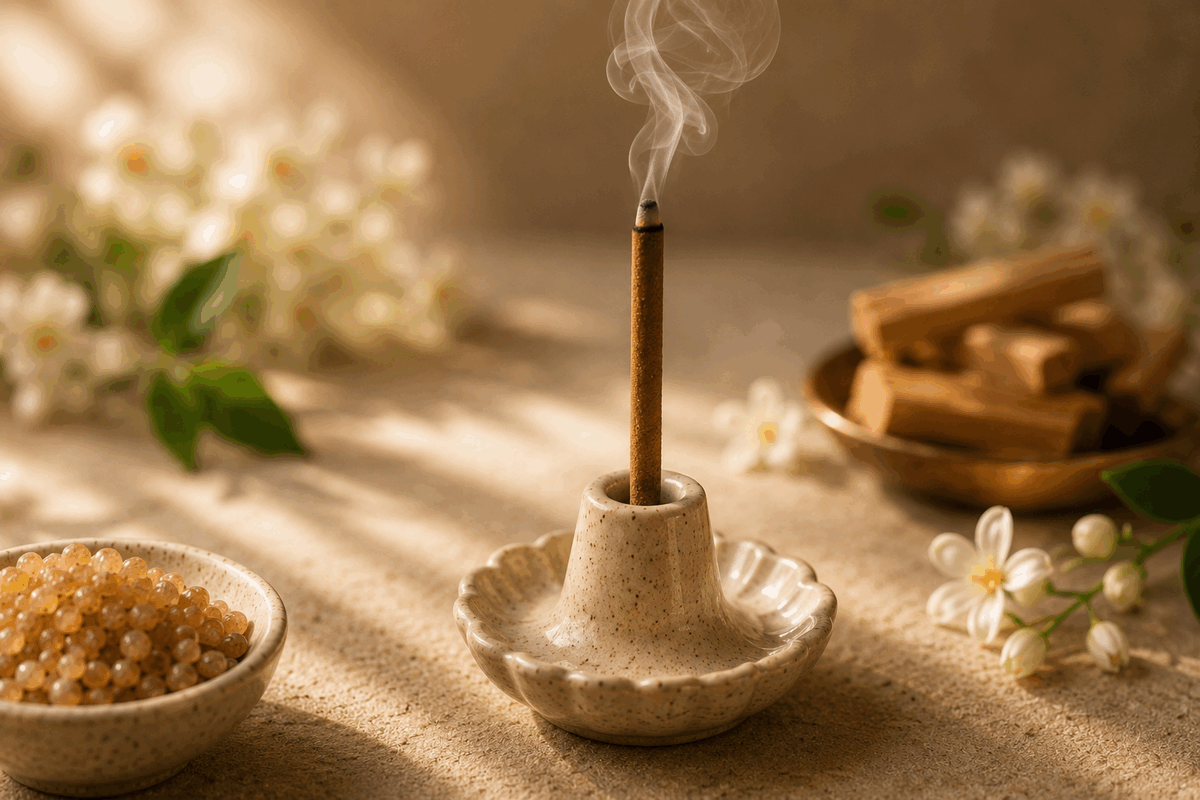
Remove the bamboo and the charcoal and you remove the reason for most of the smoke. A coreless dhoop stick is extruded entirely from the fragrant material itself: resin, flower, sandalwood dust, and a natural plant binder called jigat. There is no wooden core to burn, so the burn is cooler and slower, and dramatically lower in particulates. What you smell is the offering, not the fuel.
How to tell in your own home
Two quick tests. First, look at the ash: fuel-heavy incense leaves a lot of dark, flaky ash, while a clean botanical burn leaves a smaller, paler trace. Second, notice the wall behind where you burn. If a brown halo builds up over weeks, that is soot from wood and charcoal, and it is the same soot you were breathing.
The point of incense was never to fill a room with smoke. It was to carry a single, honest fragrance into the air. When nothing burns but the offering, the ritual feels lighter, because it is.